The Man Became a Hermit
Made by too many rooms to feel native to one, a man discovers that his hermitage has become both his safety and his prison.
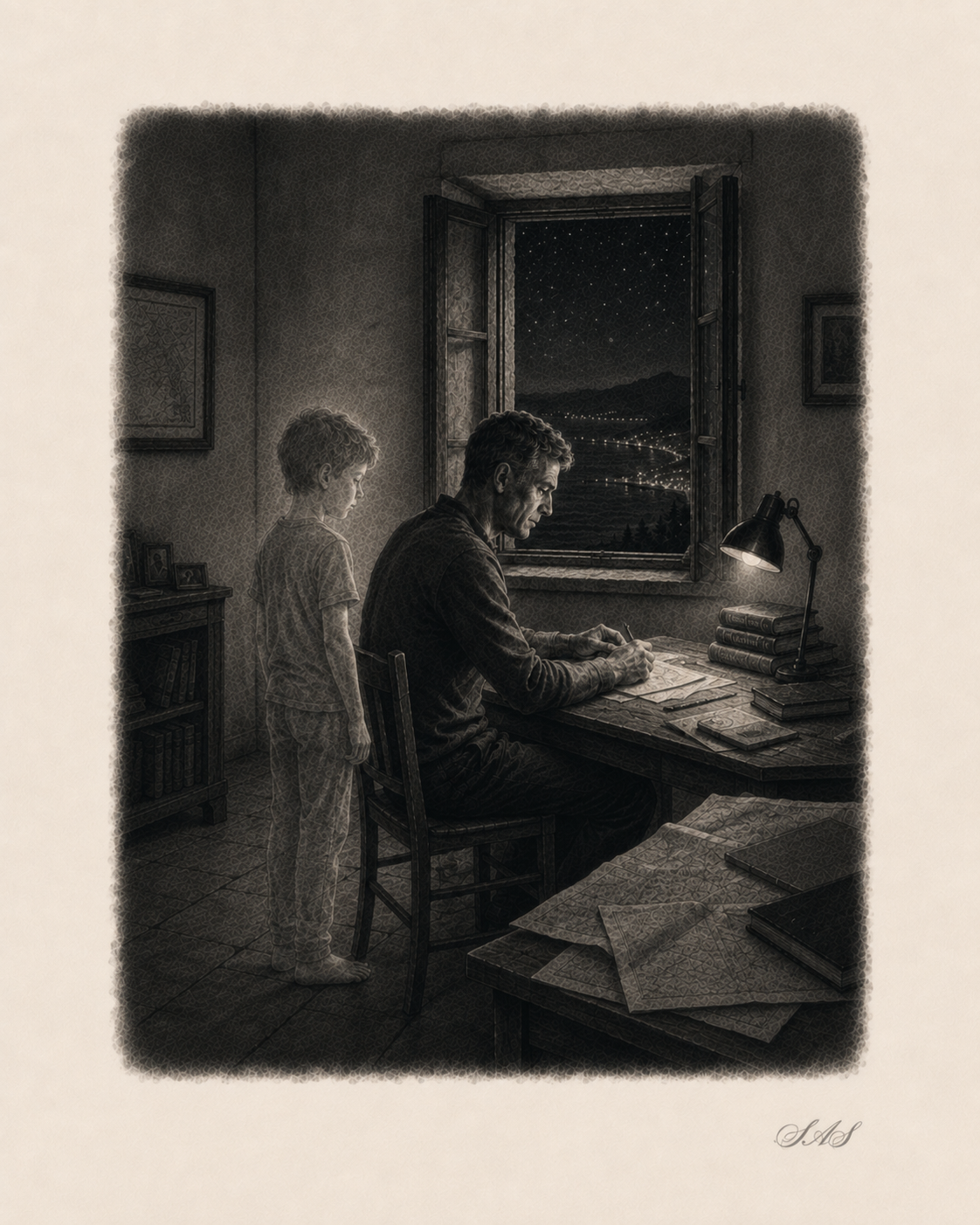
The man did not hate people.
That would have been easier.
Hatred had edges. Hatred could be pointed at something. Hatred could stand in a doorway with a dramatic little cape and announce itself like a villain with decent branding.
But this was not hatred.
This was stranger.
The man could relate to almost anyone.
That was the problem.
He could sit across from a bartender with old grief hiding under jokes, a soldier who had learned to smile with only half his face, a woman carrying loneliness inside good manners, a man pretending power had cured fear, a drunk trying to sound philosophical, a mother running on fumes, or a stranger at a gas station who said three ordinary sentences and accidentally revealed the architecture of his whole life.
The man could hear it.
Not always the details. Not always the facts.
The frequency.
He had been tuned by too many places, too many rooms, too many kinds of weather. He had lived among different cultures long enough for pieces of them to move into him and rearrange the furniture. He had absorbed gestures, cadences, silences, food, danger, music, humor, grief, warmth, suspicion, hospitality, cruelty, prayer, profanity, and the many small ways people ask to be loved without using those words.
Culture had entered him by osmosis.
Not academically.
Bodily.
He had accumulated places the way war-torn men accumulated scars.
Some remembered. Some forgotten. Some unwanted. Some intentional.
Mexico City. Berlin. Cairo. Cusco. Berkeley. Miami. Florence. Buenos Aires. Tbilisi. Barcelona. Bordeaux. London. Santiago. Bermuda. Kuwait. Christchurch. Lviv. Adelaide. Guangzhou. Vancouver. Elysian. Chicago. Lisbon. Mumbai. Brussels. Stellenbosch. Savannah. Manhattan. Portland. Paris.
Mexico City again.
The list did not feel like travel when he said it back to himself.
It felt like evidence.
He had known bright places with tragedy mixed into them, as if beauty had never learned how to arrive alone. Machu Picchu gave him the sublime, the old stones cut against impossible green, the altitude making even wonder feel like a discipline of breath. Lima gave him the catacombs, the ordered bones beneath the church, death arranged with more patience than the living usually offered one another.
He learned early that the world did not separate its miracles from its graves.
That lesson followed him.
From a foster home in Elysian to the libraries on the campus of Berkeley.
From rooms where survival was practical and quiet to rooms where old books breathed dust and ambition, where young minds mistook vocabulary for wisdom, where the world could be argued into shape beneath green lamps, high windows, and the soft arrogance of possibility.
He belonged to both places.
That was part of the problem.
He could sit with the orphan and the scholar, the soldier and the poet, the hustler and the professor, and find the human thread in each of them. Not because he was pretending. Because something in him had been built from all their materials.
A Yemeni grocer once taught him more about dignity than any statesman had managed.
The man stood behind his counter with tired eyes and exact hands, weighing fruit, counting bills, speaking in three languages without announcing the miracle of it. He carried exile in his posture, faith in his pauses, and a kind of humor that had survived too much to be casual. From him, the man learned that civilization was sometimes just a small shop kept open with stubborn grace.
A French winemaker taught him that memory could be bottled but never controlled.
The winemaker spoke of soil as if it were family, of weather as if it were politics, of grapes as if they were difficult children who might still become remarkable with the right amount of suffering. He had hands that understood patience and a face that had made peace with disappointment. From him, the man learned that place entered everything. Even taste. Even longing.
A street performer in Florence taught him about devotion disguised as spectacle.
The performer stood in a piazza beneath old stone and tourist hunger, turning his body into comedy, music, and prayer for coins. Around him, the city preened in its Renaissance costume, all marble and memory, while this living man fought for attention beneath the weight of dead masters. From him, the man learned that art was not always framed. Sometimes it sweated. Sometimes it begged. Sometimes it made children laugh while adults pretended not to be moved.
A drunk in London taught him that truth sometimes wore a ruined coat.
He had found the man somewhere between pub light and rain, all red cheeks and ancient sorrow, speaking with the theatrical precision of someone who had lost everything except language. The drunk had been ridiculous and profound in alternating sentences. He cursed God, praised his mother, insulted the Crown, and then said something so cleanly human that the man carried it for years. From him, the man learned not to dismiss the oracle because it smelled of gin.
A muse in Manhattan taught him that desire could make a city taller.
She moved through the island as if the avenues had been arranged for her entrance. She was not merely beautiful. Beauty was too simple a word and therefore suspicious. She was kinetic. Electric. A private weather system in good shoes. Around her, restaurants sharpened, taxis glittered, and the skyline seemed less built than summoned. From her, the man learned that some people do not enter your life. They alter its lighting.
A false enemy in Iraq taught him that history was a machine that fed on ordinary men.
He had been taught where to point his suspicion. He had been given maps, uniforms, language, rules, and reasons. But the face across the divide was still a face. A man with a mother. A hunger. A fear. A private joke. A childhood. Some small object he kept because it meant home.
The enemy became false not because danger was absent, but because the story was incomplete.
From him, the man learned that politics makes abstractions, then sends bodies to prove them.
A thief in Bermuda taught him that paradise had teeth.
The water had been too blue to accuse anyone of anything. The air smelled like salt, flowers, money, and escape. Yet even there, someone wanted what was not his. Even there, beauty did not cancel appetite. Even there, the postcard had a shadow just outside the frame. From him, the man learned that no island was innocent simply because it photographed well.
Everywhere, someone had handed him a piece of the world.
Not always kindly.
Not always knowingly.
Some gave him music. Some gave him warning. Some gave him hunger, wine, scripture, betrayal, laughter, fear, tenderness, and the heavy education of watching people reveal themselves when they believed no one important was looking.
Music. Sports. Food. Wine. Literature. Art. Physics. Psychology. Politics. Religion.
He moved through these subjects the way he moved through cities, not as a tourist but as a trespasser who had somehow been invited in. He could speak to the musician about ache, to the athlete about discipline, to the cook about memory, to the wine person about land, to the reader about loneliness, to the artist about compulsion, to the physicist about invisible forces, to the psychologist about rooms beneath rooms, to the political mind about power, to the religious soul about mercy and terror and the old human problem of being small beneath something vast.
By outward appearance, he had become a modern renaissance man.
A chameleon.
An information booth.
A confessional.
People came to him with questions and left with themselves.
That was his strange usefulness. He could become legible in almost any room. He could adjust his language, his posture, his humor, his intensity, not falsely but fluently. He could sit beside a stranger and locate the hidden hinge in the conversation. He could listen to someone talk about food and hear their mother. He could listen to someone talk about politics and hear their fear. He could listen to someone talk about God and hear the child still bargaining with the dark.
This made people feel close to him.
Of course it did.
He did not blame them.
There was no crime in finding warmth by a fire.
But the man had mistaken fluency for belonging too many times to keep making the error.
He could relate to anyone.
Deeply.
Fundamentally.
Almost dangerously.
And still feel alien.
That was the paradox.
Not that others failed to reach him.
Not that he was above them.
Not that his complexity made him superior, though vanity had occasionally tried that cheap little coat on him and found the fit embarrassing.
No.
The paradox was him.
He had been made by too many places to feel native to one. He had learned too many languages of the soul to believe any single one could carry him home. He had become expert at crossing into others, but remained unsure how to let anyone cross into him.
He was the bridge.
The witness.
The translator.
The open door and the locked room.
The information booth that could direct everyone else home and still stand under its little sign after dark, unsure where to go.
Even as a boy, he could move between rooms.
That was one of the first tricks survival taught him.
Read the weather.
Adjust the voice.
Become useful.
Become charming.
Become quiet.
Become funny.
Become whatever shape reduced danger.
It worked.
That was the problem with useful adaptations. They had a nasty habit of growing up with you and applying for management positions.
The boy became a man who could adapt to almost anyone.
An orphaned man. An Army veteran. A father. Divorced. Street smart because streets had spoken to him plainly. Intellectual because thought had given him somewhere to go when rooms became unsafe. An empath because he had needed to know what people felt before they did something with it. High EQ, high IQ, high vigilance, high tolerance for absurdity.
A ridiculous resume for a human soul.
Very impressive.
Very tiring.
Through the years, there had been a great deal of giving.
Giving had been safe.
Giving kept him useful. Giving kept him welcomed. Giving allowed him to stand near intimacy without having to ask for it directly. He could offer wisdom, steadiness, humor, insight, protection, tenderness, language, and strength. He could become the man others leaned on, the man others trusted, the man others found when their own weather turned dangerous.
It was a role he knew how to play because it had never felt like a role.
It had felt like survival.
He could make space. He could listen without flinching. He could find the human thing beneath the performance and touch it gently. He could ask the question behind the question. He could sit with contradiction. He could hold darkness without making a sermon out of it. He could make people feel less alone in places they had been sure were uninhabitable.
They would look at him afterward with softened eyes.
There you are, their faces seemed to say.
There I am, he would think.
But he was not there.
Not in the same way.
People felt close to him because he could reach them.
He felt far away because reaching was not the same as arriving.
He had mistaken that difference for arrogance before. Then for damage. Then for depression. Then for standards. Then for fatigue. Then, on especially uncharitable days, for proof that he had become cold.
But none of those explanations held the whole truth.
The truth was more awkward.
He was an alien with excellent translation skills.
A very convincing one too.
He had learned the local customs. He knew when to nod, when to laugh, when to soften his voice, when to ask the second question, when to tell the small self-deprecating joke that made the room trust him. He knew how to make himself appear reachable.
That was not the same as feeling reached.
He could be sitting six feet from someone who believed they were sharing an intimate moment with him, and some part of him would be watching from the far side of glass.
Not judging.
Not rejecting.
Just observing.
There is a particular loneliness in being good at connection.
People do not suspect it.
They see the warmth and assume it is evidence of belonging. They feel seen and assume the seer must feel seen too. They mistake his ability to enter their world for proof that someone has entered his.
But the man knew the difference.
He had always known it.
But eventually, the debt came due.
The man began to show signs of giving up on life. Not in the dramatic way people knew how to recognize, but in the quieter, more frightening way. Hope withdrew. Sleep broke apart. The world became harder to enter. His body carried the evidence. His spirit stopped reaching so easily for tomorrow.
So he did what he had spent a lifetime making possible for others.
He sought help.
He reached toward the people who had known him as resilience. As determination. As wisdom. As strength.
And there, the paradox widened.
It was no longer only inside him.
It lived in the distance too.
Because some people could not bear to see him vulnerable. Not really. Not fully. The man who had been their proof of endurance had become evidence of fragility, and that was too frightening to hold for long. It was safer to believe he would snap back. Safer to believe he would return to form. Safer to wait for him to become again what he had so freely been before.
The giver.
The translator.
The fire.
The confessional.
The one who could carry the unbearable thing and still make room for everyone else.
To see him as truly breakable meant admitting the possibility of losing him. Not to weakness. Not to failure. But to the tragedy he had spent years keeping away from his own hands.
So they stepped back.
Not always out of indifference.
Sometimes out of fear.
Sometimes out of helplessness.
Sometimes because his strength had taught them the wrong lesson.
And the man, already fluent in abandonment, understood too much.
That was its own cruelty.
He understood their fear. He understood their distance. He understood the comfort of believing the resilient man would remain resilient because the alternative was too terrible to name.
But understanding did not make it painless.
So he began withdrawing.
Not dramatically.
There was no cape.
No final announcement.
No candlelit oath taken beneath a thunderstorm, though he would admit the theater of that had some appeal.
He simply became harder to reach.
A delayed reply.
A declined invitation.
A vague “I’ve been tired.”
A morning inside.
Then another.
Then the apartment began to feel less like a place he lived and more like a border checkpoint.
Inside: controlled climate, familiar objects, known threats, acceptable silence.
Outside: variables.
People called it isolation.
He called it rest.
Then safety.
Then hermitage.
The word pleased him at first.
Hermitage sounded intentional. Ancient. Almost holy. Like he had not disappeared, but retreated to a mountain to contemplate truth with a bowl of soup and an unreasonable amount of dignity.
That was a nicer story than fear.
That was a nicer story than a man becoming slowly boxed in by the very walls that had once helped him breathe.
My hermitage, he thought.
My safety.
My prison.
He did not like the order of those words.
He liked even less that all three were true.
The hermitage protected him from thin conversation, from disappointing rooms, from the weird grief of being liked but not known, from the fatigue of giving people access to his warmth while keeping his own deepest self behind reinforced glass.
It protected him from being misunderstood.
Mostly.
Nothing protected him completely from that.
Misunderstanding was very committed. It always found a window.
But the hermitage did protect him from the immediate burden of trying.
No need to explain the paradox.
No need to soften the intensity.
No need to perform ordinary.
No need to decide whether someone was safe enough to receive one more true sentence.
There was relief in that.
There was also a cost.
The cost arrived quietly at first.
A day with no real human voice in it.
Then two.
Then a week where the outside world became something he viewed through screens, windows, delivery notifications, and the distant sound of other people continuing to belong to things.
He was not jealous exactly.
Jealousy required believing he wanted what they had.
He was not sure he did.
That uncertainty frightened him more than envy would have.
Once, he had wanted rooms.
Many rooms.
Rooms with music, rooms with women, rooms with arguments worth having, rooms full of strange accents and new stories, rooms where someone might say something so alive that it changed the angle of the evening.
He had wanted the world.
Not all of it.
But enough.
Now the world felt loud before it even arrived.
A text message could feel like a knock.
A knock could feel like an accusation.
An invitation could feel like a test he had not studied for.
He knew this was not freedom.
He was too honest to lie about that.
The hermitage was not only peace. It was avoidance with better lighting.
Still, he could not bring himself to despise it.
It had kept him intact.
That mattered.
There were seasons when staying alive did not look like blooming. It looked like dishes done. Medication taken. Rent handled. Floors clean enough. No bottle. No collapse. No dramatic surrender to the ancient appetite for self-destruction.
There were seasons when survival wore pajamas and spoke to no one.
Fine, he thought.
But let us not confuse this with arrival.
That was the conversation he began having with himself.
Not aloud, usually.
Though sometimes aloud.
A man living alone was entitled to a little theatrical muttering. It was practically in the lease.
This is safety, he told himself.
This is also a prison.
This is protection.
This is also disappearance.
This is rest.
This is also fear wearing slippers.
He did not say it cruelly.
That mattered.
Cruelty had never healed him. It had only made him more obedient to pain.
He was trying a different method now.
Truth without the whip.
He could admit he felt alien without turning alienation into destiny.
He could admit he did not feel close to people without accusing them of failing to reach him.
He could admit that people often loved the access he gave them while never touching the chamber where he actually lived.
But he could also admit that some of that chamber was guarded by him.
Not because he was bad.
Because he had learned.
Because the boy had learned.
The boy had learned that people could stand very near and still not be safe.
The boy had learned that being understood in pieces was sometimes safer than being known whole.
The boy had learned that if he became fluent in everyone else, no one would notice he had no native land of his own.
That was the alien part.
Not green skin.
Not a spaceship.
Nothing so convenient.
Just a man who could speak the languages of many human needs while remaining privately unsure where he belonged.
A man who could make others feel less alone and then go home to a room where the silence knew his real name.
A man who could relate to anyone on deep and fundamental levels, then feel almost nothing when they mistook that depth for mutual arrival.
He did not want to blame them for that.
That would be too easy.
Most people were not trying to use him.
Most people were simply relieved.
They had found someone who could listen without shrinking.
They had found someone who could meet them beneath the surface.
They had found someone who made them feel, briefly, like the hidden thing was not so hidden.
Of course they felt close.
That made sense.
He was the one with the strange internal math.
He was the paradox.
The open door and the locked room.
The warm fire and the distant planet.
The man who could translate everyone and still not know how to say, in any language, I am lonely in a way your closeness does not reach.
So what was he supposed to do with that?
The old answer was isolation.
The older answer was performance.
The worst answer was finding someone wounded enough to confuse intensity with home.
He had tried that one.
Several stars.
Would not recommend.
The new answer had not fully arrived yet.
It was still somewhere out beyond the tree line, making noise in the dark.
But he could sense its outline.
Maybe the answer was not to abandon the hermitage.
Not immediately.
Maybe the answer was to stop pretending it was only a sanctuary.
Maybe the answer was to keep the fire, but open a window.
Not throw open the gates.
Not invite the whole village.
God, no.
The village had opinions and casseroles and follow-up questions.
Just a window.
A small one.
Enough air to remind him the world still existed.
Enough contact to prove the walls were not permanent.
Enough honesty to say: I am not blaming anyone. I am not above anyone. I am not unreachable because I lack feeling. I am unreachable because I have lived too long as a translator and forgotten what it feels like to speak without subtitles.
The man sat with that.
The room was quiet.
Not mountain quiet. Not holy quiet. Not the grand cinematic quiet of a life changing forever while soft music manipulates the audience into believing healing has a soundtrack.
Apartment quiet.
Refrigerator humming.
Air conditioner breathing.
A car passing somewhere outside.
The ordinary machinery of continuing.
He looked around at the clean-enough room, the objects in their places, the little evidence that some part of him still cared enough to maintain a world.
The hermitage had not consumed him.
Not yet.
That was important.
A prison did not usually keep itself this tidy unless the prisoner was also the warden, the architect, the maintenance staff, and the small stubborn committee still voting in favor of eventual release.
He almost smiled at that.
Almost.
The boy inside him did not ask to leave immediately.
The boy was not stupid.
The boy knew the outside had weather.
But he came a little closer.
Not brave exactly.
Interested.
That was enough.
The man did not promise him the world.
He had learned to be careful with promises. The boy remembered them all.
Instead, the man made a smaller vow.
We will tell the truth about the walls.
The boy listened.
We will not call the prison only safety.
The room hummed.
We will not call safety only prison.
That seemed fair.
We will not blame them for feeling close.
The boy shifted.
And we will not blame ourselves for feeling far away.
There it was.
The sentence entered the room like air through a cracked window.
Not rescue.
Not revelation.
Air.
The man breathed it in.
For now, that was enough.
He was still an alien.
Still a translator.
Still a man made of too many rooms, too many cultures, too much darkness, too much empathy, too much intelligence, too much history, too much ache.
Still the paradox.
But maybe a paradox was not a defect.
Maybe it was a door with two truths standing on either side.
Maybe the work was not to solve himself.
Maybe the work was to stop abandoning either side.
The hermitage remained around him.
Safety.
Prison.
Home, for now.
But somewhere inside it, a window had opened.
Only a little.
Only enough.
And for the first time in a long while, the man did not mistake the smallness of the opening for failure.
He knew better now.
Small openings were how sealed rooms learned weather.
Small openings were how prisoners remembered sky.
Small openings were how aliens began, carefully, to test the atmosphere of earth.