The Boy Wanted to Camp
A man drives away from a final fight, crosses storms and elevation, and discovers that sobriety was only the beginning of learning how to protect the boy inside him.
The man drove away after the final fight with one hand on the wheel and the other resting uselessly near his phone, as if some part of him still expected it to light up with an apology, an accusation, a rescue flare, or one more little grenade dressed as a text message.
It did not.
The phone stayed dark.
Good, he thought.
Then, almost immediately:
Please.
That was the problem with him. There was always a man trying to leave and a boy hoping to be called back.
So the man had done something cruel.
Not accidentally cruel.
Not one of those soft little human mistakes people make when language gets ahead of the heart.
He had said regrettably nasty things. Chosen things. Things with hooks in them. Things designed to land badly and stay there. He had taken the ugliest parts of his fear, sharpened them into sentences, and thrown them across the room because some terrified animal in him believed that if he made the ending ugly enough, he could finally stop returning to it.
An insurance policy.
That was what it had been.
A terrible one.
The kind of policy that protects you from going back by making sure there is nothing gentle left to go back to.
He hated that he had done it.
He hated that a part of him had meant to.
The boy had wanted a locked door.
The man had built one out of words.
Outside, Florida answered with one of its brutal summer micro-storms, the kind that arrived almost every day around three in the afternoon like the sky had a recurring appointment with madness.
One minute the world was sweating under a white-hot sun, asphalt shimmering, palms pretending they were not exhausted, the air so thick it felt like the whole state was breathing through a wet towel.
The next minute, violence.
Rain hit the windshield so hard it sounded personal.
Not weather.
A verdict.
The wipers fought bravely and stupidly, dragging themselves back and forth across the glass like two tired arms trying to clear a grief too large for them. For one second, the road appeared. Then it vanished again beneath another sheet of water.
He leaned forward slightly, as if posture could improve visibility.
It could not.
The rain kept coming.
The sky was having the cry he would not let himself have.
That was generous of it, in a way. A little dramatic, maybe, but he respected commitment.
Inside the car, everything was damp without being wet. His shirt. His hands. His chest. The air between him and the phone. The argument still sitting beside him like an unwelcome passenger who had refused to get out at the last exit.
His watch buzzed against his wrist.
High resting heart rate.
Helpful, he thought.
Nothing like a small rectangle of technology calmly informing a man that his body had filed a formal complaint.
He did not remember every word from the fight.
Only the shape of it.
The escalation.
The old electricity.
The moment both of them stopped trying to be understood and started trying to survive.
That was always the ugliest part. Not the yelling. Not the words. Not even the particular cruelty two people can find when they know exactly where the soft places are.
The ugliest part was the transformation.
One minute, there were adults in the room.
The next, there were children with better vocabularies and worse weapons.
The woman had become a girl.
He had become a boy.
And then the man and the woman, wherever they had gone, could only watch from far away while the children set the furniture on fire.
He hated that.
He hated how quickly it happened.
He hated how familiar it felt.
He hated that a part of him still confused familiar with true.
The rain came harder.
Fine, he thought. Go ahead.
Cry, then.
Somewhere behind his ribs, the boy did.
Not loudly.
The boy never cried loudly.
Loud crying attracted attention, and attention was not always safe. So he cried the way he had learned to cry: inward, silent, organized, almost polite. A tidy little devastation. Very considerate. Five stars. Would recommend to anyone hoping to become an adult with excellent emotional suppression and a suspiciously high tolerance for chaos.
The man kept driving.
The Florida lights smeared across the windshield. Red, white, amber, green. Every color bleeding into every other color until the world looked like a painting left out in the rain.
Behind him was the relationship.
Or what remained of it.
Ahead of him, eventually, was Colorado.
The mountains.
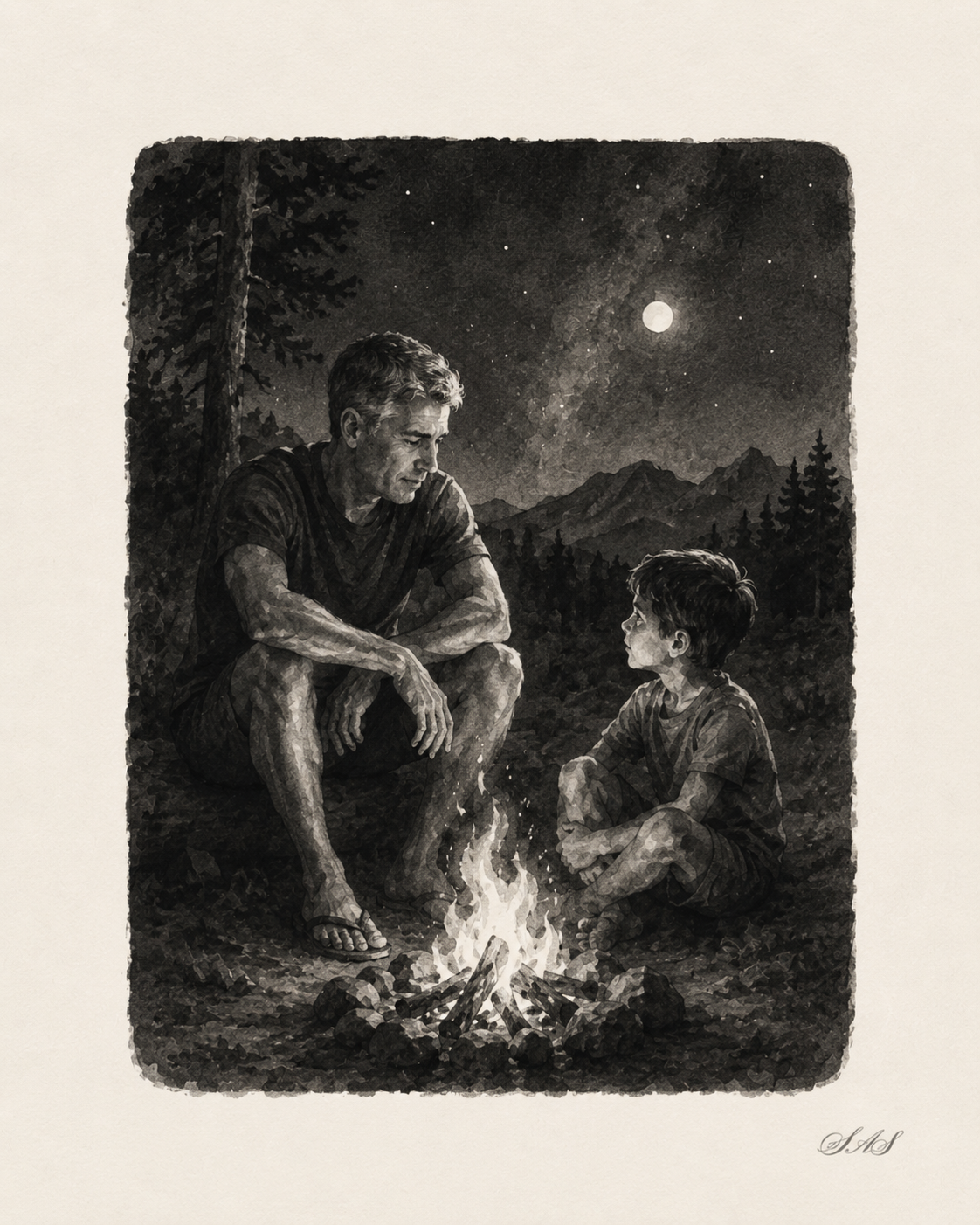
The boy had wanted to camp.
That sounded ridiculous, even to him. A grown man leaving another toxic relationship's final fight and heading toward the mountains because a boy inside him wanted a tent, a fire, cold air, and a place where nobody could find them.
But there it was.
The boy wanted to camp.
The boy wanted to be away from doors that slammed.
Away from voices that sharpened.
Away from the familiar terror of someone else's nervous system becoming the weather in the house.
Away from love that felt like guessing the password to a room that kept changing locks.
The boy wanted somewhere safe.
And for once, the man did not tell him to be quiet.
For once, the man did not say, “Later.”
For once, the man did not hand him a woman to love, a problem to solve, a crisis to manage, a body to hold, a mess to clean up, a feeling to translate, or a life to rescue in the hopes that rescue would finally feel like being chosen.
For once, the man said:
Okay.
We’ll go.
The road became hours.
Then states.
Then a kind of moving room where memory did not need permission to enter.
The man drove through weather, through dark, through Tesla Superchargers.
Those strange little modern waystations for people pretending they are in control because their cars have maps, percentages, estimates, and elegant screens that turn uncertainty into numbers.
Thirty minutes.
That was usually what it took.
Thirty minutes to sit beneath hard white parking-lot light while the car drank electricity and the man tried not to drink the past. Thirty minutes with nowhere useful to go. Thirty minutes too short to become a new person and too long to pretend he was only waiting on the battery.
The car charged.
The man did not.
Or maybe he did, but badly.
In tiny increments.
A few percent at a time.
Enough to keep going.
Not enough to know where he was going.
Leaving a woman.
Leaving a pattern.
Leaving the room where he had said the things he could not unsay.
Not because he was proud.
He was not.
He carried those words with him like contraband.
They sat in the passenger seat beside the silent phone, ugly and effective.
That was the shame of it.
They had worked.
He had wanted to make return impossible, and he had.
The man could admit that now, or was beginning to. He had not only been hurt. He had hurt. He had not only been misunderstood. He had become the kind of person who made himself impossible to misunderstand by becoming unmistakably cruel.
There was relief in that.
There was disgust in that.
Both were true.
The boy did not know what to do with both.
The man barely did.
At some point, the road began to climb.
At first, he barely noticed. Grief had taken most of his attention, and shame had taken the rest. But then his ears tightened. A strange pressure bloomed inside his head. The sound of the road changed. The car seemed farther away from itself.
He swallowed.
Nothing.
He swallowed again.
Pop.
The world came back slightly wrong.
He hated that too.
The body always knew before the mind.
His ears knew he was changing elevation before his thoughts knew he was changing perspective.
That felt unfair.
The body should at least have the decency to file a report.
Instead, it just tightened, popped, shifted, a small internal announcement that he was leaving one atmosphere and entering another.
The man drove higher.
The boy listened.
The woman’s voice came back in fragments.
Not all of it. Just pieces.
The parts that hurt.
The parts that were probably true.
The parts that were unfair.
The parts that were only unfair because they were close enough to true to bruise.
That was the worst kind.
He had learned to defend himself against lies. Lies had edges. You could pick them up, turn them over, identify the bad craftsmanship.
But partial truths were harder.
Partial truths moved like smoke.
Yes, he could be distant.
Yes, he could disappear into himself.
Yes, he could make someone feel locked out.
Yes, he could be intense and then unreachable, which was a fairly rude combination, like inviting someone into a cathedral and then turning off all the lights.
Yes, he could be too much.
Yes, he could also not be enough.
He laughed once, sharply, alone in the car.
That one was a real achievement.
Too much and not enough at the same time.
A complex little buffet of disappointment.
The boy did not laugh.
The boy was still staring out the window.
The man knew him well enough by then. The boy was not thinking about the fight exactly. The boy was thinking about all the fights.
All the rooms.
All the versions of love that started with warmth and ended with him trying to explain why he deserved to be treated gently.
And before all of those rooms, there was Boulder.
Boulder was not only a place on a map to him.
It was the first weather.
The original pressure system.
The place where he had been born into chaos before he had any words for chaos, before he had any defenses, before he knew that a child could enter the world already inside a story he did not choose.
People spoke about Boulder like it was all clean air, intelligent bicycles, mountains, coffee, and people named Skylar with opinions about compost.
And yes, Boulder could be beautiful.
That was part of the confusion.
Beautiful places could still hold harm.
Beautiful places could still be the beginning of a nervous system learning to watch the room.
The boy knew Boulder differently.
The boy knew it as origin.
Not destiny.
But origin.
The boy remembered the women differently than the man did.
The man remembered the stories.
The boy remembered the feeling.
A kitchen.
A bedroom.
A hallway.
A phone lighting up at the wrong time.
A face changing.
A silence that became a weapon.
A sentence that sounded like a door locking.
The boy remembered what it was like to scan someone’s expression and search for the danger before it arrived. To hear the tiny shift in tone that meant the evening had changed. To feel responsible for moods he did not create. To become charming, useful, funny, agreeable, sexually alive, intellectually dazzling, emotionally available, spiritually patient, and secretly terrified.
That boy had become very good at surviving love.
Which is not the same thing as receiving it.
The man drove.
The old Florida storm was gone by then, but it stayed inside him.
That was how storms worked when they were also grief.
They moved through the sky and remained in the body.
He thought about alcohol.
Not because he wanted a drink.
He didn’t.
That surprised him sometimes. Not the sobriety itself, but the quiet after the wanting changed shape. There had been a time when alcohol seemed like the obvious villain. It had left evidence. Empty bottles. Damaged mornings. Apologies with no architecture behind them. Promises made with sincerity and no foundation. A body tired of being used as a hiding place.
Alcohol had been visible.
Conveniently visible.
A villain with fingerprints.
But he had been sober for some time now.
And still, here he was.
Driving away from another ending with the boy shaking inside him.
That was the part that frightened him.
Not because sobriety had failed.
It had not failed.
Sobriety had saved his life in ways both obvious and invisible. It had returned mornings to him. It had given him the dignity of remembering. It had stopped him from pouring gasoline on rooms that were already full of sparks.
But sobriety had not raised the boy.
Sobriety had not taught him how to choose safety over intensity.
Sobriety had not taught him that chemistry could be a trauma response wearing perfume.
Sobriety had not taught him that being needed was not the same as being loved.
Sobriety had removed the bottle from his hand.
It had not removed the child from the driver’s seat.
That thought arrived quietly.
Then it filled the whole car.
He gripped the wheel.
He had blamed the alcohol because alcohol was visible.
But the boy was quieter.
The boy left fingerprints on choices.
On attachments.
On attractions.
On silences.
On exits.
On returns.
On the women he chose.
On the women he chased.
On the women he tried to love.
On the women he could not love, no matter how much he respected them, no matter how kind they were, no matter how well they looked on paper, no matter how badly he wanted to be the kind of man who could accept a good-enough life and stop bothering the universe with his inconvenient longing.
The boy had been driving.
Not maliciously.
That mattered.
The boy was not evil.
The boy was not trying to destroy him.
The boy was trying to get home with a map drawn during a disaster.
That realization hurt more than blame.
Blame was easier.
Blame gave him somewhere to point.
Understanding gave him someone to hold.
The road climbed.
His ears popped again.
This time he let it happen.
The pressure built, released, changed the sound of the world.
Confusion, he thought.
That’s what this is.
A change in pressure.
Not madness.
Not doom.
Not proof that he was broken beyond repair.
Just pressure.
A body adjusting to elevation.
A mind adjusting to truth.
There should be signs for this, he thought.
CAUTION: EMOTIONAL ALTITUDE CHANGE.
EXPECT TEMPORARY MUFFLING, DISORIENTATION, AND THE SUDDEN REALIZATION THAT YOUR ENTIRE PERSONALITY MAY HAVE BEEN ORGANIZED AROUND PROTECTING A CHILD YOU KEEP PRETENDING IS NOT IN THE CAR.
He almost smiled.
Almost.
The boy did not mind the joke.
The boy liked when the man made jokes, as long as the jokes did not become a way of leaving him alone.
That had happened before.
Humor could be warmth.
Humor could also be a trapdoor.
He knew the difference now.
Or he was learning.
The higher he drove, the more the world changed. The road darkened. Trees appeared as black shapes against a darker sky. The air thinned. The city-self began to peel away from him in strips.
The car filled with mountain silence.
Not absence.
Presence.
That was different.
City silence always had machinery underneath it. Refrigerators humming. Pipes knocking. Tires hissing. People arguing behind walls. Someone somewhere always failing to parallel park with appropriate humility.
But mountain silence had depth.
It did not ask to be filled.
The man rolled down the window a few inches.
Cold air entered the car.
Clean.
Sharp.
Almost rude.
He inhaled and felt it cut through him.
The air was too clean for the version of him that had left that house. Too honest. Too unperfumed. Too free of accusation. It had no interest in his explanations.
It simply entered.
His lungs expanded.
The boy noticed.
Again, not loudly.
The boy was subtle. A tiny shift. A softening near the center. A hand unclenching somewhere in the dark.
They could breathe here.
That was the first mercy.
Not happiness.
Not healing.
Breath.
Breath was enough.
For a while, he drove without thinking in words.
Only images came.
A younger version of himself standing in a room where nobody noticed he was scared because he had learned to look capable.
A woman crying while he comforted her, though he was the one who had been hurt.
His own hands washing a glass in a kitchen that did not feel like home.
A song he once played for someone who did not understand why it mattered.
The old burn of being misrepresented.
The older burn of being taken for granted.
The oldest burn of feeling unseen and then blaming himself for needing to be seen at all.
The boy watched these images pass.
The man did too.
Neither of them turned away.
That was new.
Usually he turned away.
Usually he converted pain into analysis. Into productivity. Into caretaking. Into desire. Into longing. Into a project. Into a woman. Into an apology. Into a paragraph so beautifully constructed it almost hid the wound it was built around.
Not tonight.
Tonight the road was long enough to let the truth keep talking.
He reached the campsite late.
The ground was wet and dark and shining under his headlights. The trees stood around him like witnesses who had seen worse and were not impressed by human drama.
That was comforting.
Trees did not ask follow-up questions.
He stepped out of the car and the cold found him immediately.
Good, he thought.
He wanted to be found by something that did not want anything from him.
The air smelled like wet earth, pine, stone, and something almost metallic. Clean in the way a blade is clean. Clean in the way a truth is clean before we start decorating it.
He stood there for a moment beside the car.
No one yelled.
No one needed him.
No one accused him of being distant because he was quiet.
No one asked him to explain the tone of his silence.
No one made his nervous system responsible for theirs.
The boy came closer.
The man could feel him now, not as panic, but as presence.
Small.
Tired.
Watchful.
Hopeful in the way hurt children are hopeful even when they pretend they are not. Hope in them is stubborn. It hides under furniture. It survives terrible management. It returns with a stick and says, “What if this is magic?”
The man opened the trunk.
Tent.
Sleeping bag.
A small stove.
A lantern.
Food packed with the quiet competence of someone who knew what mattered when comfort was no longer pretending to be civilization.
He began setting up camp.
Not poorly.
That would have been dishonest.
The man knew how to do this.
He knew how to make shelter. He knew how to read weather. He knew how to handle cold, wet, dark, distance, discomfort, and the practical little problems that become very large problems when ignored. The Army had taught him some of it. Time had taught him the rest. Experience had taught him the parts that manuals leave out because manuals are written by people who sleep indoors.
The tent went up cleanly.
A pole went here.
A stake went there.
The rainfly pulled taut.
The boy liked this.
The boy liked that the problem was simple.
The boy liked watching the man know what to do.
There was no subtext in it.
No one said, “I’m fine” in a way that meant start guessing.
No one withdrew affection because a zipper caught.
No one punished him for not knowing immediately how to make shelter.
Shelter could be learned.
That was another mercy.
Eventually, the tent stood.
Not majestically.
But well enough.
A small, imperfect structure in the wet dark.
He stood back and looked at it.
The boy looked too.
We did that, the boy seemed to say.
Yes, the man answered.
We did.
He made a small fire where fire was permitted, because the rules mattered and he was not interested in becoming the subject of a ranger’s disappointed lecture.
The flame took slowly.
At first, just smoke.
Then a timid glow.
Then a little orange tongue of life.
He fed it carefully.
Not too much.
That was important.
Fire had to be tended, not smothered.
There were probably several metaphors available there, but he was too tired to chase them.
He sat beside it.
The night gathered around him.
Cold behind him.
Warmth in front.
The boy beside him.
Not in the distance now.
Beside him.
For a long time, the man said nothing.
He watched sparks rise and vanish.
He thought about all the times he had tried to be chosen by becoming indispensable.
All the times he had mistaken someone’s need for intimacy.
All the times he had offered emotional shelter to women who never learned how to build their own.
All the times he had called it love when it was really labor.
All the times he had been gentle with everyone but himself.
That one landed hardest.
He had been so gentle.
God, he had been gentle.
With women.
With friends.
With children.
With strangers.
With wounded people who did not know how to stop bleeding on him.
With people who misunderstood him.
With people who took his consideration and treated it like a renewable utility.
With people who gave him less than he gave and somehow made him feel demanding for noticing.
He had made room.
He had adjusted.
He had anticipated.
He had forgiven.
He had studied the people he loved like sacred texts.
He had remembered how they took their coffee, what songs made their eyes change, what subjects made them defensive, what kind of silence meant tired and what kind meant danger, what they wanted for dinner when they said they didn’t care, what childhood ache hid beneath which adult complaint.
He had loved like an archivist.
Like a shelter.
Like a weather system trained to move around someone else’s crops.
And all along, the boy had waited.
Not angrily.
That would have been easier.
The boy waited quietly.
He waited the way children wait when they do not yet understand that no one is coming because the person who was supposed to come is them, older now, tired, sitting beside a fire in the Colorado mountains after another final fight.
The man put his face in his hands.
This time, he cried.
Not dramatically.
No operatic sobbing.
No cinematic collapse onto damp earth while the camera pulled back and some indie song with a banjo did emotional labor.
Just a hard, private, adult cry.
The kind that does not ask to be witnessed.
The kind that has been waiting years for permission and then, when permission finally comes, does not know how to behave.
The boy cried with him.
Or maybe the boy had been crying all along and the man finally joined him.
That felt more true.
The fire kept burning.
The trees stood there.
The mountains did not comfort him exactly.
They allowed him.
That was better.
Comfort sometimes tried too hard.
Allowance was cleaner.
Be here, the mountains said.
Be this.
Be the man who failed.
Be the boy who hurt.
Be the sober man who still made mistakes.
Be the good man who caused pain.
Be the gentle man who sometimes disappeared.
Be the empathic man who overgave until he became resentful.
Be the observant man who saw everything except the child asking for him.
Be all of it.
The man lowered his hands.
The fire blurred.
Then sharpened.
He took a breath.
Cold air entered him again.
Crisp.
Exact.
Renewing, but not sweet.
There was nothing sentimental about it. It did not tell him he was amazing. It did not hand him a mug that said HEALING JOURNEY in a terrible font. It did not absolve him.
It cleaned him.
There is a difference.
Absolution asks nothing.
Cleansing asks you to see what is actually there.
And what was there?
A man.
A boy.
A history.
A pattern.
Not a curse.
That mattered.
He was not cursed.
He was patterned.
Patterns could be studied.
Patterns could be interrupted.
Patterns could be loved into something new.
He had thought healing would mean finding the right woman.
A woman who could finally see him.
A woman who could meet his mind.
A woman who could love the strange museum of him, all the bright rooms and haunted rooms and half-finished exhibits with handwritten signs saying PLEASE DO NOT TOUCH, STILL UNDER INVESTIGATION.
He still wanted that.
He would not lie about it.
He wanted a woman on his level.
Someone deep.
Curious.
Tender.
Alive.
Someone who understood music as weather and silence as language and touch as a form of truth. Someone who could look at a city from above and feel both grief and possibility. Someone with a woman inside her who had survived and a girl inside her who still hoped, even if she hid it under sarcasm, standards, and excellent boots.
But the fire showed him the danger.
Not in wanting her.
In needing her to do the work he had not yet done.
He could not hand the boy to her.
He could let her meet him one day.
Maybe.
If she was gentle.
If she had earned it.
If he had earned it too.
But he could not place the boy in her arms and call that intimacy.
He could not make a woman responsible for a child she did not wound.
And he could not make the girl in her responsible for saving the boy in him.
That was how houses burned.
No.
The man had to become the safe place first.
Not perfect.
Safe.
There was a difference.
Perfect was sterile and suspicious and probably had white furniture.
Safe had books on the floor.
Safe had soup.
Safe had boundaries.
Safe said no without cruelty.
Safe said yes without self-abandonment.
Safe could disagree and stay kind.
Safe could hear pain without becoming obedient to it.
Safe could admit harm without becoming only harm.
Safe could hold the boy without letting the boy drive.
The fire cracked.
The boy listened.
The man said it then.
Quietly.
Out loud.
“I’m sorry.”
The words vanished into the trees.
He was not sure who he meant.
The women he had hurt.
The women he had let hurt him.
The woman he had just wounded on purpose so he could not return.
The boy.
The man.
All of them, probably.
“I thought it was the drinking,” he said.
The fire answered with a small collapse of ash.
Which was either profound or just physics.
“I thought if I stopped, I’d stop.”
There it was.
The sentence.
The little blade.
I thought if I stopped, I’d stop.
But he had not stopped.
Not all the way.
He had stopped drinking.
He had not stopped abandoning himself.
He had stopped numbing with alcohol.
He had not stopped choosing chaos that felt like home.
He had stopped blacking out.
He had not stopped disappearing into other people’s needs.
He had stopped poisoning his body.
He had not stopped letting the boy confuse panic with love.
That was not failure.
It was information.
Hard information.
Holy information, if one was feeling generous and the firelight was doing flattering things to the soul.
He looked at the tent.
The boy had wanted to camp.
That was all.
Not a mansion.
Not a woman.
Not an apology.
Not proof.
A tent.
A fire.
A place where no one could harm them.
The simplicity of it broke him open in a new way.
The boy had not wanted the world.
The boy had wanted safety.
And the man had spent years trying to get safety from people who did not have it to give.
Or would not.
Or could give it sometimes and then withdraw it when the girl in them got scared.
That was the other truth.
He was not the only one with a child inside him.
Everyone arrived with someone smaller.
The woman had a girl in her.
Of course she did.
A girl who had learned things too early.
A girl who had her own weather.
A girl who watched for abandonment, betrayal, dismissal, control, contempt, inconsistency, hunger, silence, rage, boredom, whatever monsters had learned her name first.
And maybe the man had loved the girl in women before he loved the woman.
Maybe he had seen the girl and thought, I know you.
Maybe his boy had reached for her girl and mistaken recognition for destiny.
Two children recognizing each other in the dark can feel like God.
It is not always God.
Sometimes it is just the dark.
He did not want that anymore.
He wanted the woman.
And he wanted to be the man.
He wanted their children to be welcome, but not in charge.
He wanted a love where the boy and the girl could sit at the table without setting the menu.
A love where the man and the woman could say:
I see what hurts in you.
I will be careful with it.
But I will not become its employee.
He smiled at that.
The boy did too.
Probably.
The fire warmed his knees.
The rest of him stayed cold.
That felt right.
Healing did not happen all at once.
Warmth arrived by region.
He slept badly.
Of course he did.
Everyone talks about sleeping under the stars like the ground is not actively trying to explain mortality to your hips.
He woke several times.
Once to wind.
Once to a noise that was absolutely either a harmless branch or a murderer-bear with excellent stealth training.
Once to nothing at all except his own mind, which had apparently decided 3:17 a.m. was an ideal time to review every mistake he had ever made in high definition.
But each time he woke, he remembered where he was.
The tent.
The mountains.
The boy.
Safe.
That word did not arrive as a feeling yet.
More like a hypothesis.
Safe.
Could this be safe?
Could he be safe with himself?
Could the man become the one the boy looked for?
By morning, the rain had cleaned everything.
The world outside the tent was wet, cold, and beginning again.
He unzipped the door and the air entered like an answer.
Not a soft answer.
A clean one.
The trees were darker from rain. The earth smelled alive. Light moved carefully over the ground, touching things one at a time, as if asking permission.
He made coffee badly.
It tasted incredible.
This is one of the great mysteries of camping. Coffee that would be considered a misdemeanor indoors becomes holy outdoors.
He drank it slowly.
His hands wrapped around the cup.
Steam rose into the morning.
The boy was calm.
Not fixed.
Calm.
The man knew better than to confuse the two.
After coffee, he hiked.
Not far at first.
His body was tired from the drive, the fight, the crying, the bad sleep, and the general inconvenience of being a person with a nervous system and a past.
But he climbed.
The trail was wet. Rocks shifted under his boots. The air thinned as he gained elevation, and again his ears filled, tightened, popped. Each release made the world sound slightly clearer.
Confusion giving way by inches.
He thought about the final fight again.
This time, not as evidence.
As data.
That was different.
Evidence convicts.
Data teaches.
He could see his part.
Not all the parts.
Not hers.
Not the whole tangled mess, because relationships are rarely crimes with one suspect and a tidy motive. They are ecosystems. Weather systems. Two histories trying to become a home without reading the manual because there is no manual, only wounds with opinions.
But he could see his part.
He had stayed too long.
He had ignored the early signs.
He had overexplained himself to someone who was not listening.
He had mistaken the chance to be understood for actual understanding.
He had let the boy keep reaching for repair from someone who kept reopening the wound.
He had called that hope.
Sometimes hope is holy.
Sometimes hope is a trap wearing good lighting.
And then, at the end, he had used cruelty as a deadbolt.
He had told himself it was necessary.
Maybe some part of it had been.
But necessary did not mean clean.
Necessary did not mean kind.
Necessary did not mean he did not have to look at the blood on the key.
He climbed higher.
The trail opened.
The sky widened.
The air became crisp enough to feel like it was entering him with a broom.
Good, he thought.
Clean the corners.
There were many.
He thought about his complexity.
That word had followed him for years.
Complex.
Sometimes it was a compliment.
Sometimes it was a warning.
Sometimes it was what people called him when they wanted the benefits of his depth without the inconvenience of his humanity.
He was complex.
Fine.
Yes.
He could admit that.
There were good complexities in him.
Gentleness.
Empathy.
Observation.
Consideration.
Depth.
Curiosity.
The strange and lovely ability to be moved by a song, a sentence, a skyline, a mathematical idea, a memory, a woman’s hand resting near his, the smell of rain on pavement, the way a child asks a question that rearranges the adult world.
There were difficult complexities too.
Fear.
Intensity.
Withdrawal.
Overthinking.
Defensiveness when shame came too close.
The instinct to scan.
The habit of reading silence as danger.
The old reflex to earn love by becoming useful.
The impulse to rescue, then resent, then blame himself for resenting what he should never have agreed to carry alone.
Good and bad.
Light and shadow.
Rooms with sunlight.
Rooms with bad wiring.
Rooms he had avoided.
Rooms he had mistaken for the whole house.
But from the trail, breathing hard in the cold morning, he understood something that softened him.
The house was worth repairing.
That was it.
Not perfect.
Not condemned.
Worth repairing.
He stopped walking.
There was a view ahead, not the full view yet, but enough to make him pause. The land fell away in layers. Trees. Rock. Road. Distance. The first suggestion of the cities below.
He was not at the top.
But he could see more than before.
That was how clarity worked, apparently.
Not one lightning strike.
A series of openings.
He kept going.
The boy came with him.
At some point, the man realized he was no longer dragging the boy behind him like evidence of damage.
He was walking with him.
That changed everything.
The boy was not a problem to solve.
The boy was a part of him to protect, teach, listen to, and occasionally prevent from texting anyone.
Firmly.
Lovingly.
With snacks.
By the time he reached the overlook, the sky had cleared.
Not completely.
There were still clouds, because the universe had taste.
But the rain had moved on, and the air had become so clean it felt almost impossible.
Below him, Boulder and Denver spread across the distance.
Boulder closer, tucked against the foothills, bright and wounded and beautiful.
The place where he had been born into chaos.
The first room, in a way.
The first weather.
The first proof that beauty and harm could occupy the same geography without asking permission from each other.
Denver farther out, wide and alive, carrying its own ghosts under a morning light that made everything seem newly negotiable.
He stood there and looked down at the places where harm had happened.
Not all harm.
That would be too simple.
There had been joy there too.
Beauty.
Music.
Desire.
Laughter.
Rooms where he had felt briefly known.
Streets where he had walked with hope in him.
Tables where he had said too much.
Beds where he had wanted to be loved so badly he ignored the cost.
Bars where the old version of him had tried to disappear.
Mornings where he woke with shame sitting on his chest.
Afternoons where he believed he was becoming better.
Nights where he became worse.
Women he had loved.
Women he had failed.
Women who had failed him.
The man he had been.
The boy who had been driving.
The chaos he had been born into.
The chaos he had recreated because the body often mistakes repetition for repair.
All of it was down there.
The sites of harm.
The sites of becoming.
From below, they had felt like traps.
From here, they looked like terrain.
That was the epiphany.
Not that the pain was gone.
Not that he was innocent.
Not that he had been wronged and everyone else should gather immediately for a ceremony honoring his resilience, though he would not object to a tasteful brunch.
The clarity was better than innocence.
He could see the pattern.
He could see the boy.
He could see the man.
He could see Boulder not as destiny, but as origin.
He could see Denver not as failure, but as field.
He could see the work.
And for the first time, the work did not look like punishment.
It looked like a blueprint.
He had spent his life loving other people in the ways he needed to be loved.
He had studied them because he wanted someone to study him.
He had protected their soft places because his had been left exposed.
He had forgiven them because he was begging, somewhere inside, to be forgiven.
He had made rooms safe for others because he did not know how to make himself safe for the boy.
And now he knew where to begin.
With him.
With them.
The man and the boy.
Not selfishly.
Finally.
The cities below did not look like a sentence anymore.
They looked like a field.
A greenfield.
Same streets.
Same rooms.
Same history.
But new meaning.
A place where something could be built without denying what had burned.
A place where he could become better without becoming simpler.
A place where he could share himself one day with someone like him.
Not identical.
God, no. One of him was plenty. The licensing would be complicated.
But someone like him in depth.
Someone with a woman strong enough to speak clearly and a girl tender enough to still wonder if love can be safe.
Someone who had done enough of her own work to not confuse intensity with intimacy, rescue with devotion, or panic with proof.
Someone who could meet the man and be kind to the boy.
Someone whose girl could sit near his boy without either of them taking over the room.
Someone who understood that peace was not boredom.
Peace was alive.
Peace was the erotic charge of safety.
Peace was music in the kitchen.
Peace was disagreement without cruelty.
Peace was a hand on the back in a crowded room.
Peace was saying, “I’m scared,” and not being punished for having a nervous system.
Peace was not having to make a case for your own tenderness.
Peace was visibility.
From the mountaintop, he could see.
That was the final gift.
The Florida storm had cried the hard cry he could not yet let himself have.
The elevation had confused him.
The air had cleaned him.
The view had clarified him.
And there, above Boulder and Denver, above the old rooms and old roads and old versions of himself, the man felt the boy stop asking to be saved by someone else.
The boy had been brought somewhere safe.
By him.
That was the beginning.
Not the ending.
Not the transformation montage.
Not the grand arrival of a fully healed man with excellent boundaries and a suspiciously symmetrical beard.
The beginning.
The man breathed in the cold mountain air.
The boy breathed with him.
Below them, the cities waited.
Not as enemies.
Not as graves.
As ground.
Green ground.
Unbuilt.
Possible.
The man put his hands in his pockets and stood there a while longer.
He did not need to rush back down.
For once, no one needed him to leave himself.
For once, no one was asking the boy to perform.
For once, the man did not abandon him for love.
He stayed.
And the view remained clear.