How I Get It on Paper: Symbiotic Disposition Therapy
There are two ways I get something true onto the page. One explains it. One reveals it. Together, they let me survive the page.
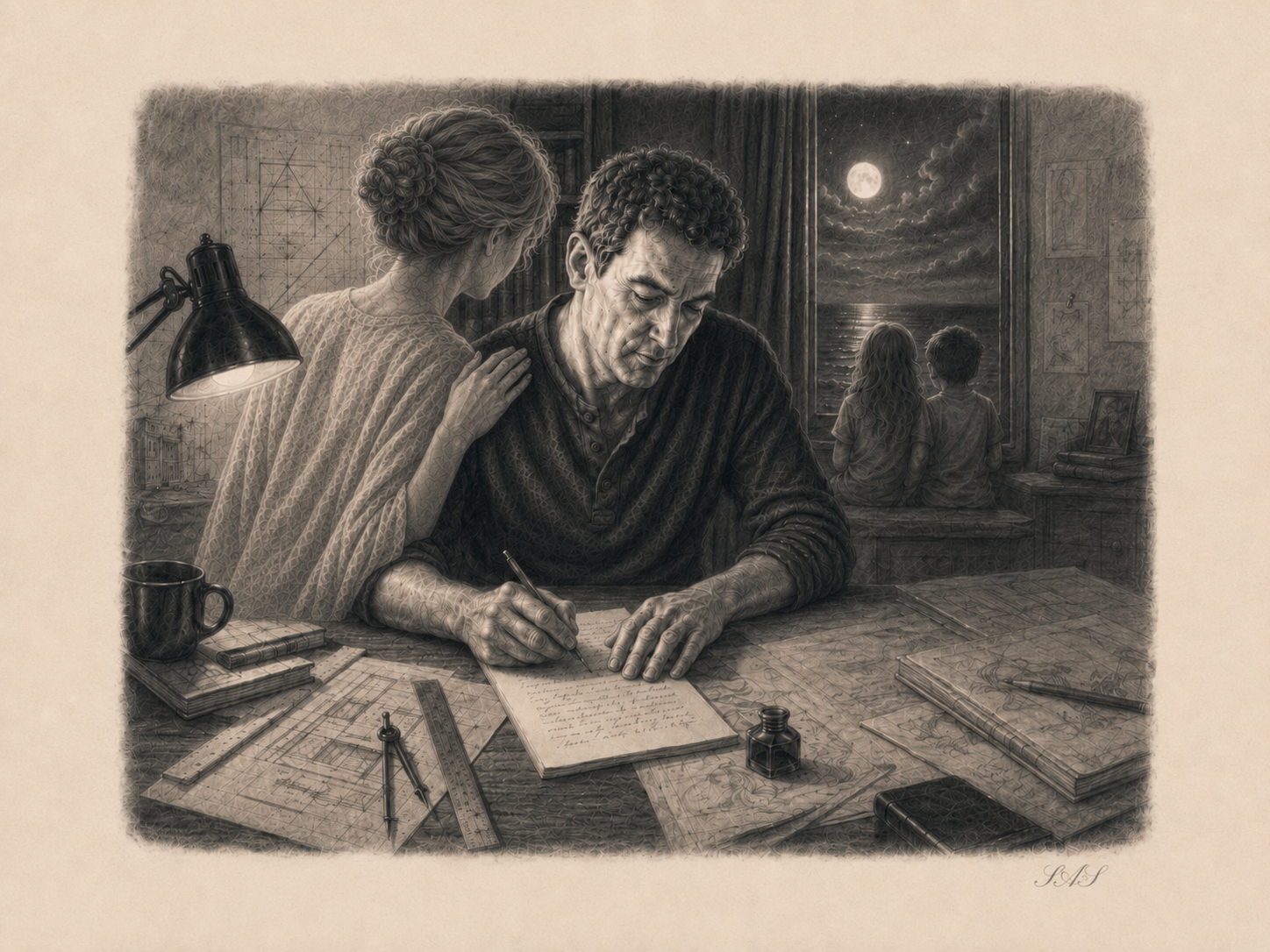
There are two ways I get something true onto the page.
The first way is structure.
The second way is surrender.
One part of me needs to understand the architecture of the thing. The pattern. The failure points. The load-bearing truths. The sequence of events. The cause and effect. The part that can say, with enough distance to survive the saying: this is what happened, this is what I did, this is what I learned, this is where the pattern lived.
That is the logic writing.
That is Engineer Scott.
But there is another part of me too.
The part that does not want to explain the wound as much as enter it. The part that speaks in water, ghosts, children, mirrors, storms, and rooms that flood without warning. The part that knows some truths cannot be understood until they are felt.
That is the Pisces writing.
Neither version is more true.
One explains it.
One reveals it.
This is how I get it on paper.
I. Logic Writing
Symbiotic Disposition Therapy
Nearly all of my relationships have been symbiotic disposition therapy.
So wrong.
So right.
It was ugly.
It worked.
Not because it was healthy. Not because it was fair. Not because either of us knew what we were doing. It worked because two unfinished people kept finding each other through the exact wounds they did not yet know how to name.
We were not always loving each other.
Sometimes we were treating each other.
Sometimes we were triggering each other.
Sometimes we were using each other as mirrors, medicine, anesthesia, confession booths, punching bags, shelter, proof, punishment, or escape.
That is an ugly thing to admit.
It is also true.
The Beginning
The Children
Before there were relationships, there were children.
Mine.
Hers.
Theirs.
All the unhealed versions of ourselves that arrived before we did. The ones carrying old confusion, old loneliness, old shame, old fear, old hunger, old hope. The ones still waiting to be chosen, seen, protected, understood, forgiven, or rescued.
Those children were always in the room.
Even when the adults were pretending to be in charge.
They chose the chemistry. They recognized the ache. They confused familiarity with safety. They mistook intensity for intimacy because intensity felt alive, and alive was close enough when numbness had been the alternative.
The children found each other first.
The adults spent years trying to explain why.
The Ugly
The ugly part is that love was not always love.
Sometimes it was dependency wearing perfume.
Sometimes it was control disguised as concern.
Sometimes it was fear dressed up as devotion.
Sometimes it was two people re-enacting old injuries and calling it passion because the body recognized the script before the mind could interrupt it.
There were moments when I thought I was loving someone, but I was really begging a wound to close.
There were moments when I thought I was being abandoned, but I was really being asked to stop outsourcing my stability to someone else.
There were moments when I thought I was choosing someone, but I was choosing the familiar shape of my own pain.
That is the ugly.
The part where I have to admit that some of my love was not as clean as I wanted it to be.
Some of it was need.
Some of it was fear.
Some of it was performance.
Some of it was survival.
The Work
The work began when I stopped asking only what they did to me.
That question mattered.
But it was not enough.
Eventually, I had to ask what I was doing there in the first place. What part of me recognized that chaos and called it home. What part of me stayed. What part of me chased. What part of me withdrew. What part of me tested, punished, withheld, pleaded, collapsed, performed, or disappeared.
That was not easy.
Because blame is simpler than ownership.
Blame gives the pain somewhere to go.
Ownership asks the pain what it is trying to teach me.
The work was learning to see the pattern without hating myself for having one. It was learning to separate accountability from shame. It was learning that I could admit I had been wounded without pretending I had never wounded anyone else.
The work was not becoming innocent.
The work was becoming honest.
The Wrong
It was wrong to make another person responsible for rescuing a child they did not injure.
It was wrong to expect love to function as a permanent anesthetic.
It was wrong to mistake emotional intensity for destiny.
It was wrong to call my fear intuition every time closeness started to feel dangerous.
It was wrong to let shame convince me I was too broken to be loved, and then punish people for failing to love me through a wall I refused to let them through.
It was wrong.
Not evil.
Not unforgivable.
But wrong.
And I need to be able to say that without collapsing into self-hatred.
Because accountability is not the same as self-destruction.
The Right
But something was right too.
That is the part I cannot ignore.
As ugly as some of it was, those relationships showed me where I still hurt. They revealed the places where I was still a child pretending to be a man. They exposed the wounds I had hidden so well that even I had started to mistake them for personality.
They showed me my fear.
They showed me my longing.
They showed me my capacity for devotion, even when that devotion was immature, misdirected, or desperate.
They showed me that I wanted love.
Not conquest.
Not control.
Not performance.
Love.
Real love.
The kind I was not yet ready to receive because I had not yet learned how to stand inside myself without apologizing for being there.
So yes, it was wrong.
And yes, something in it was right.
Because it brought the hidden children into the light.
The End
The Recovered Children
The end is not revenge.
The end is not blame.
The end is not deciding that every person who hurt me was a villain or that every person I hurt was simply collateral damage from my pain.
The end is recovery.
The children do not disappear.
They recover.
They stop running the whole house. They stop choosing partners from panic. They stop confusing abandonment with every boundary, and intimacy with every wound that feels familiar.
They are still here.
Mine is still here.
But he is no longer alone.
He does not have to hijack my life to be heard. He does not have to turn every relationship into a rescue mission. He does not have to search for a mother, a witness, a savior, a mirror, and a judge inside the same person.
He can be loved by me now.
That changes everything.
Because when the child is no longer abandoned inside me, I do not need to turn another person into his emergency room.
I can love differently.
I can choose differently.
I can stay present without collapsing.
I can leave without destroying.
I can want without begging.
I can be seen without immediately preparing to disappear.
Nearly all of my relationships were symbiotic disposition therapy.
So wrong.
So right.
Ugly as hell.
But somehow, it worked.
Not because they saved me.
Because they showed me where I still needed to recover.
II. Pisces Writing
The Recovered Children
Nearly all of my relationships have been symbiotic disposition therapy.
So wrong.
So right.
Ugly.
Holy.
Human.
It was never just love. I know that now.
It was ache meeting ache in the dark and calling itself recognition. It was two wounded children looking through adult eyes, reaching for each other across years neither of us had survived cleanly.
We thought we were choosing partners.
But sometimes, I think our ghosts chose first.
The Beginning
The Children
Before the first kiss, before the first promise, before the first collapse, there were children.
Mine.
Hers.
Theirs.
Little unfinished souls standing quietly inside adult bodies, carrying their small lanterns through the ruins. They knew things we had forgotten we knew. They knew the shape of absence. They knew the temperature of abandonment. They knew how to recognize another person’s wound before either adult had spoken its name.
That is where it started.
Not in romance.
Not in reason.
Not in compatibility.
In recognition.
The children saw each other from across the room and whispered, there you are.
The adults mistook that for fate.
Maybe it was.
Maybe fate is not always beautiful at first.
Maybe sometimes fate arrives covered in soot, carrying a mirror you do not want to look into.
The Ugly
The ugly was that we called so many things love because love was the only word holy enough to cover the mess.
Need became love.
Fear became love.
Possession became love.
Collapse became love.
The familiar ache in my chest became love because I had felt it before, because it knew my name, because it came from somewhere old enough to feel true.
I wanted to be held, but I also wanted to be hidden.
I wanted to be chosen, but I did not know how to remain visible once someone reached for me.
I wanted her to see me, but not too clearly.
I wanted her to save the child in me without ever letting her know how much he was bleeding.
That was the ugly.
Not that I was evil.
Not that she was evil.
Not that they were evil.
The ugly was that we were often children with adult weapons.
Silence.
Withdrawal.
Testing.
Need.
Shame.
Performance.
Panic dressed as intuition.
Intuition drowned by panic.
We hurt each other in languages we had learned before we had names for pain.
And still, there were moments of real beauty.
That almost made it harder.
Because nothing is more confusing than something unhealthy that also contains truth.
The Work
The work did not begin when I understood them.
The work began when I could no longer avoid myself.
There is a terrible kind of mercy in finally seeing your own pattern. It does not arrive gently. It does not knock. It floods the house.
Suddenly, I could see the rooms I kept rebuilding.
The same window.
The same locked door.
The same child waiting at the same threshold, hoping this time someone would enter without leaving.
I had spent years asking why they could not love me correctly.
A fair question.
An incomplete question.
The deeper question was quieter.
Why did I keep handing my youngest wounds to people who were carrying their own?
Why did I ask another human being to become a shoreline when they were also drowning?
Why did I confuse being needed with being loved?
Why did peace feel suspicious?
Why did chaos feel intimate?
The work was not a clean ascension.
It was not a staircase.
It was a descent.
Down through memory.
Down through shame.
Down through every room where I had abandoned myself and called it survival.
The work was learning to sit beside the child in me without asking anyone else to retrieve him.
The work was becoming the witness I had been begging for.
The Wrong
It was wrong.
I need to be able to say that without turning myself into a monster.
It was wrong to make someone else responsible for a wound they did not create.
It was wrong to ask love to perform resurrection.
It was wrong to punish people for not knowing how to enter a house I had hidden from myself.
It was wrong to chase, wrong to vanish, wrong to test, wrong to confuse intensity with devotion, wrong to treat anxiety like prophecy, wrong to make someone else prove I was not disposable while I was still disposing of myself.
It was wrong.
And still, I understand why it happened.
That is the strange mercy of recovery.
I can finally tell the truth without using it as a blade.
I can look back and say, yes, that hurt people.
I can also say, yes, I was hurting.
Both are true.
Neither erases the other.
The ocean does not become innocent because it was wounded by the moon.
It still drowns what it drowns.
The Right
But something was right too.
Something underneath the wreckage was trying to live.
That is the part I cannot betray.
There was a reason I kept reaching.
There was a reason I kept searching.
There was a reason love, even in its distorted forms, kept finding the hidden places in me and pressing its hand against the glass.
Those relationships revealed the child.
They brought him up from the basement.
They showed me where he was still hungry, still scared, still waiting for a face to soften when he entered the room.
They showed me that beneath all my defenses, all my analysis, all my retreating, all my strange distance, I still wanted to be loved.
Not admired.
Not managed.
Not decoded.
Loved.
I wanted someone to find the boy inside the storm and not look away.
And maybe that was unfair.
Maybe no lover should be asked to become that kind of witness.
But the longing itself was not wrong.
The longing was sacred.
The method was wounded.
That distinction matters.
Because I do not want to kill the part of me that wanted love.
I want to recover him.
The End
The Recovered Children
The end is not a trial.
It is not a verdict.
It is not me standing over the past with a clean robe and clean hands, pretending I did not crawl here through mud.
The end is softer than that.
Sadder too.
The end is the children finally being found.
Not by the people we tried to turn into saviors.
By us.
Mine comes back to me slowly.
Barefoot.
Suspicious.
Eyes full of weather.
He does not trust peace yet. He still looks toward the door. He still studies faces for signs of leaving. He still believes love might vanish if he needs too much or speaks too plainly.
But he is here.
And I am learning how to keep him.
I do not ask him to disappear so I can look healed.
I do not shame him for the ways he tried to survive.
I do not hand him to strangers and call it intimacy.
I sit with him.
I tell him the storm is over when it is over.
I tell him when it is not.
I tell him he is allowed to want love without making a temple out of the first person who offers warmth.
I tell him we can be lonely without being lost.
I tell him we can be seen without being consumed.
I tell him we can love without bleeding on everything we touch.
Maybe that is what all of this was.
Not failure.
Not fate.
Not punishment.
A dark, crooked kind of therapy.
Soul against soul.
Wound against wound.
Child against child.
A symbiosis of unfinished things trying desperately to become whole.
So wrong.
So right.
Ugly.
Holy.
Human.
And somehow, through all of it, the children began to recover.
Coda
That is how I get it on paper.
First, I build the frame.
Then, I let the water in.
The logic writing helps me understand what happened without drowning in it.
The Pisces writing lets me feel what happened without reducing it to a diagram.
Both are necessary.
The engineer gives the wound a structure strong enough to hold.
The mystic gives the wound a language soft enough to tell the truth.
One explains it.
One reveals it.
Together, they let me survive the page.