Building, Not Rebuilding
Terrorist of Love scares me because it asks me to share myself before I feel fully ready to be seen. But it has also allowed me to discover my own discovery of myself.
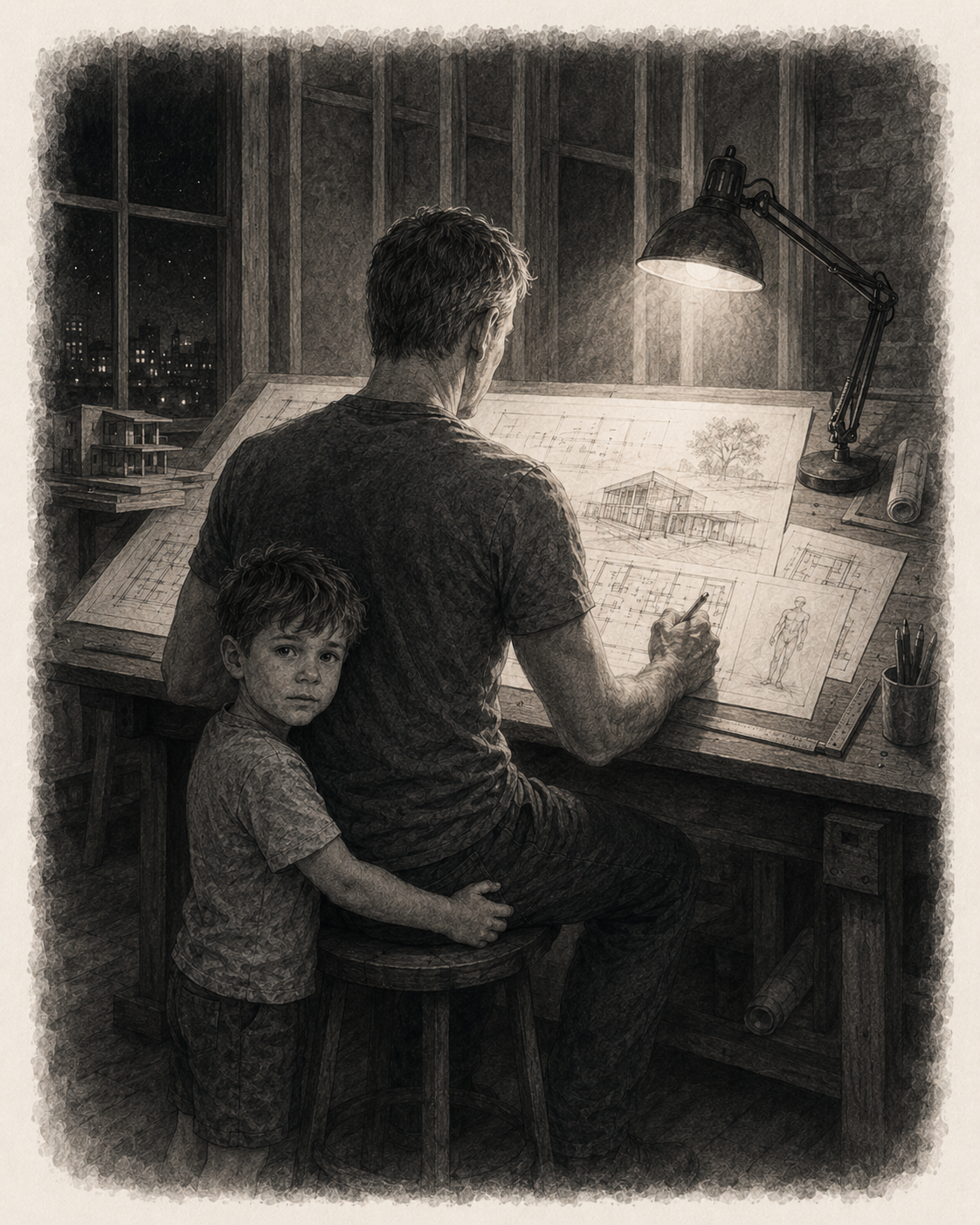
This experiment scares me.
Terrorist of Love scares me.
It scares me because it asks me to share myself before I feel fully ready to be seen. It asks me to put language around things I am still learning how to understand. It asks me to be honest in public while parts of me are still private, tender, uncertain, and under construction.
But it has also given me something I did not expect.
It has allowed me to discover my own discovery of myself.
Terrorist of Love may look new from the outside, but the product of it spans more than ten years. This is not something that appeared suddenly. It is the result of a long, winding, painful, beautiful, confusing, necessary path to here.
It started with Forced Introspection.
That was where the excavation began. That was where I first started turning inward with enough honesty to see that something deeper was happening inside me. At the time, I may not have fully understood what I was naming, but I was beginning to recognize that my life, my behaviors, my reactions, my defenses, my love, my fear, and my identity were all connected to a story I had not yet fully learned how to tell.
Forced Introspection was the beginning of looking.
Terrorist of Love is the beginning of sharing.
The writing, the reflection, the emotional excavation, the questions, the grief, the hope, the searching, the love — all of it has been collecting for years. Some of it lived in silence. Some of it lived in private notes. Some of it lived in relationships, mistakes, lessons, losses, and moments I did not yet have the language to explain.
TOL is not the beginning of the story.
It is the first place where the story has started to take shape outside of me.
That may sound strange, but it feels true. Through this space, I am not simply writing about who I am. I am meeting myself in real time. I am noticing the places where fear still lives. I am finding language for the parts of me that were once only reactions, defenses, patterns, or pain. I am learning how to witness myself without immediately judging, correcting, or abandoning what I find.
Self-discovery is a strange kind of excavation.
It is scary and exhilarating. Sobering and hopeful. It asks me to look at myself honestly, but not cruelly. It asks me to stand in the middle of everything I have survived and everything I have become, and choose love anyway.
Not the easy kind of love. Not the decorative kind. The grounded kind. The kind that does not require me to abandon myself to be understood by someone else.
I am still too brittle to share myself freely with others.
That is not weakness. That is honesty.
There are parts of me that are still tender to the touch. Parts of me that are learning the difference between being seen and being exposed. Parts of me that want connection, but still flinch when connection starts to feel like pressure, expectation, or performance.
But I am learning that the fear does not mean I should stop.
It means I should move with care.
One of the harder parts of this process is learning how to live with both sides of myself at the same time.
I have an analytical and logical mind. It is sharp. It notices patterns. It evaluates risk. It searches for cause and effect. It tries to understand before it trusts. It wants evidence, structure, consistency, and reason. In many ways, that mind has protected me. It helped me survive confusion. It helped me make sense of pain. It helped me organize chaos into something I could manage.
That is the engineer in me.
The engineer wants to understand the system. The engineer wants to identify the failure points, trace the load, inspect the structure, and solve the problem. The engineer wants things to make sense because sense has often felt safer than uncertainty.
But logic can become a locked room if I let it make every decision alone.
There is another part of me too.
A compassionate part. A hopeful part. A part that still believes in love, softness, repair, beauty, tenderness, and possibility. A part that wants to remain open even after all the reasons I have been given to close. A part that does not want my intelligence to become a fortress so secure that nothing human can reach me.
That is the struggle.
My mind wants to analyze everything so I can stay safe.
My heart wants permission to hope without being cross-examined.
And I am trying to learn that these parts of me do not have to be enemies. My logic does not have to extinguish my compassion. My hope does not have to dismiss my discernment. I do not have to choose between being thoughtful and being tender. I do not have to choose between protecting myself and remaining capable of love.
The work is integration.
What I am experiencing is not a simple change. It is not a rebrand, a reset, or a new season of the same old self. It is a transformation. It is an adaptation. It is the slow and deliberate work of understanding which parts of me were chosen and which parts of me were built as trauma-based outcomes.
That distinction matters.
Because for a long time, I carried certain patterns as if they were proof of some permanent flaw in me. As if every protective behavior was a moral failure. As if every maladaptive response was something I had voluntarily selected from a place of clarity and control.
But that is not the whole truth.
Some of what I became was survival architecture.
Some of what I called personality was protection.
Some of what looked like avoidance was injury.
Some of what appeared defensive was actually a nervous system doing what it knew how to do with the tools it had at the time.
That does not absolve me of responsibility. It does not erase impact. It does not mean I get to hide behind my history and call it healing.
But it does mean I can tell the truth without destroying myself in the process.
I do not need resentment to explain my pain.
I do not need guilt to prove I care.
I do not need shame to become accountable.
There is another way.
Accountability. Ownership. Tempered remorse.
That is the path I am trying to walk now.
Accountability without self-erasure.
Ownership without self-hatred.
Remorse without the performance of endless punishment.
I can regret what hurt others without agreeing that I am only the worst thing I have ever done, said, tolerated, feared, or failed to understand. I can hold the weight of my choices without letting that weight become a grave. I can acknowledge the ways I have been shaped by trauma without making trauma the author of every chapter still left to write.
I am not rebuilding myself.
That word does not feel right anymore.
Rebuilding suggests there was once a complete structure that simply needs to be restored. It suggests returning to some earlier version of myself, as if the goal is to reconstruct what existed before the damage.
But I am not trying to go back.
I am building.
I am building from what I know now. From what I have survived. From what I have learned. From what I refuse to repeat. From what I still believe is possible.
I am building a self where my mind and my heart are allowed to coexist.
A self where discernment does not cancel compassion.
A self where logic supports healing instead of policing it.
A self where hope is not treated as foolishness just because pain once made cynicism feel safer.
And when I am ready, I will build around me.
Not randomly. Not desperately. Not from loneliness. Not from fear.
With complementary and carefully curated architecture and design.
I want a life that fits the person I am becoming. I want relationships that do not require me to shrink, perform, chase, or defend my right to heal at my own pace. I want people, spaces, rituals, work, love, and purpose that support the structure I am creating instead of compromising its foundation.
That will take time.
And I am learning to let it.
There is hope in that. A quiet kind of hope. The kind that does not rush the process or demand evidence every day. The kind that says: keep going, even when you are scared. Keep telling the truth, even when your voice shakes. Keep choosing love, even when love looks like boundaries, solitude, patience, or starting over differently than anyone expected.
I am not finished.
But I am no longer willing to confuse unfinished with broken.
I am under construction.
And now I understand the work differently.
I am not only the engineer.
I am also the architect.
The engineer in me understands how things are built, how they break, how they can be repaired, reinforced, tested, and made stronger. But the architect in me is learning to imagine what should exist in the first place. The architect is learning to design with intention, beauty, compassion, purpose, and love.
For most of my life, I have been engineering survival.
Now I am architecting myself.
My plans.
My build.